
From the Workshop
to the Web
The name “ToolGrid” isn’t random. It comes from a real, physical tool organization system that inspired how we think about structuring digital tools, and it shapes everything about how our platform is built.
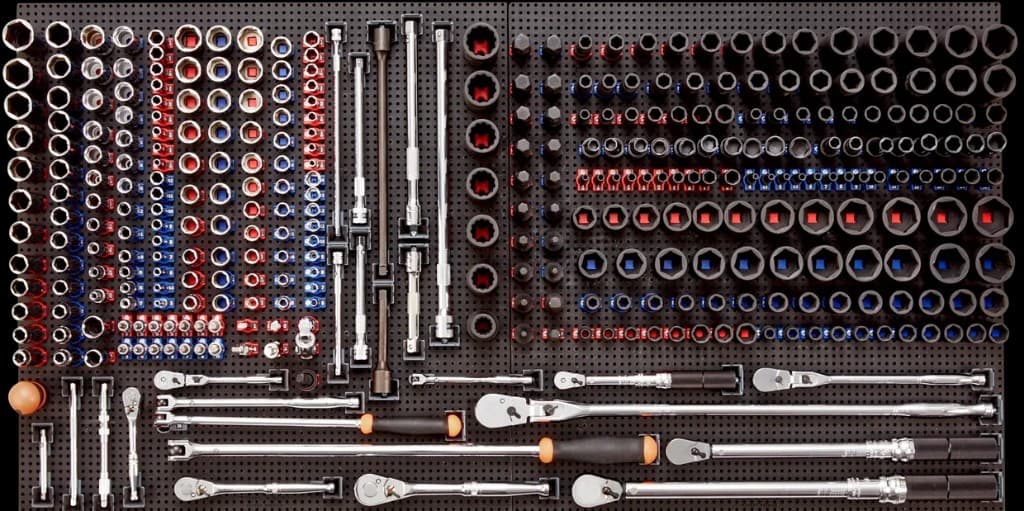
What Is the ToolGrid System?
ToolGrid is a patented, modular tool organization system used in professional workshops from automotive garages to aerospace labs. It consists of durable plastic boards with a precise grid of thousands of holes, and over 53 types of specialized holders that lock into place.
Instead of piling tools into a drawer and hoping for the best, the ToolGrid system gives every tool a defined place. Boards connect together, holders snap in, and the entire layout can be customized, scaled, and reorganized as your toolset grows.
ToolGrid® is a registered trademark of its respective owner. ToolGrid.io is not affiliated with or endorsed by the ToolGrid® product. The physical system serves purely as a conceptual inspiration for our digital platform.
The Same Philosophy, Reimagined for the Web
We took the core principles of the physical ToolGrid system (structure, modularity, visibility, and scalability) and applied them to how we organize digital tools.
Physical Workshop
The original ToolGrid system
Boards
The foundation, modular boards that connect together and scale to any workspace size.
Holder Types
53+ specialized holders, socket holders, wrench holders, ratchet holders, each designed for specific tools.
Individual Tools
Each tool snaps into its holder, visible, secure, and instantly accessible.
Labels
Labels identify tools and holders for quick visual lookup across the system.
ToolGrid.io Platform
Our digital adaptation
Collections
The foundation, broad groupings like Document Processing, Image Tools, or Calculators. Like boards, they define the workspace.
Categories
Specialized groups within a collection, like PDF Tools, Image Converters, or Financial Calculators. Like holder types, each category is purpose-built.
Tools
Individual utilities, JSON Formatter, PDF Merger, Color Picker. Each tool sits in its category, ready to use instantly.
Tags
Cross-cutting labels that help you discover tools across collections, like “developer”, “converter”, or “AI-powered”.
How It All Fits Together
Just like the physical system, every piece nests logically within the next.
Collections
e.g. Document Processing, Image Tools, Developer Utilities
Categories
e.g. PDF Tools, Image Converters, JSON Utilities
Tools
e.g. PDF Merger, JSON Formatter, Base64 Encoder
Why This Concept Matters
The ToolGrid philosophy isn’t just a naming choice: it’s a design principle that guides every decision we make about the platform.
Findability Over Clutter
In a physical ToolGrid, every tool is visible at a glance. On ToolGrid.io, every tool is searchable, browsable, and categorized, never buried or hidden.
Modularity by Design
Physical boards connect to grow. Our collections and categories work the same way, the platform expands without breaking its structure.
A Place for Everything
No loose tools rattling around. Every utility on ToolGrid.io belongs to a collection, sits in a category, and carries tags that connect it to related work.
How ToolGrid.io Will Grow
Just like the physical ToolGrid system can expand by connecting more boards and adding new holder types, our platform is built to grow organically, without ever losing its structure.
New Collections Expand the Grid
As new domains emerge, AI tools, security utilities, data science, design tools, new collections are added. Each collection is like adding a new board to the grid: it connects seamlessly to the existing system without disrupting anything.
New Categories Fill the Gaps
Within each collection, new categories appear as needs arise. Just like adding new holder types for different tool sizes, our categories grow to accommodate specialized utilities, from API testing to data visualization to accessibility checkers.
New Tools Snap Into Place
Every new tool we build finds its natural home in an existing category and collection. The structure is already there, the tool just clicks in. No redesign needed, no navigation overhaul, no confusion for users.
Tags Create Cross-Grid Connections
Tags let tools be discoverable across collections. A "converter" tag connects a PDF converter in Document Processing to an image converter in Image Tools, creating pathways that transcend the hierarchy, just like labels on a physical ToolGrid.
The Grid Never Stops Growing
The vision is a single platform where any everyday digital task, formatting, converting, calculating, analyzing, generating, validating, has a tool ready to go. The ToolGrid structure ensures that no matter how large the platform gets, everything remains organized, accessible, and fast.
Inspiration, Not Affiliation
ToolGrid.io is a digital platform inspired by the concept and philosophy of the physical ToolGrid® modular tool organization system. We admire the elegance of its approach, giving every tool a defined, visible, and accessible place within a scalable structure, and we’ve adapted that same thinking for organizing digital tools on the web.
ToolGrid.io is not affiliated with, endorsed by, or connected to the makers of the ToolGrid® physical product. The physical ToolGrid® system is a patented product and registered trademark of its respective owner. All rights to the ToolGrid® name and product belong to their rightful holders. We reference it here solely to credit the original inspiration behind our platform’s name and organizational philosophy.
Explore the Grid
Browse our collections, discover categories, and find the exact tool you need. Everything is organized, everything is accessible, and the grid keeps growing.